Background
NeRF learns a continuous volumetric representation of a scene from posed images, enabling novel view synthesis. In the few-shot regime (3–10 views), NeRF suffers from underdetermination: there are not enough observations to constrain the MLP. A natural idea is to condition NeRF on rich semantic features from foundation models like DINO (a self-supervised ViT), which can provide scene priors.
This paper asks: does DINO actually help when views are extremely scarce?
Models Evaluated
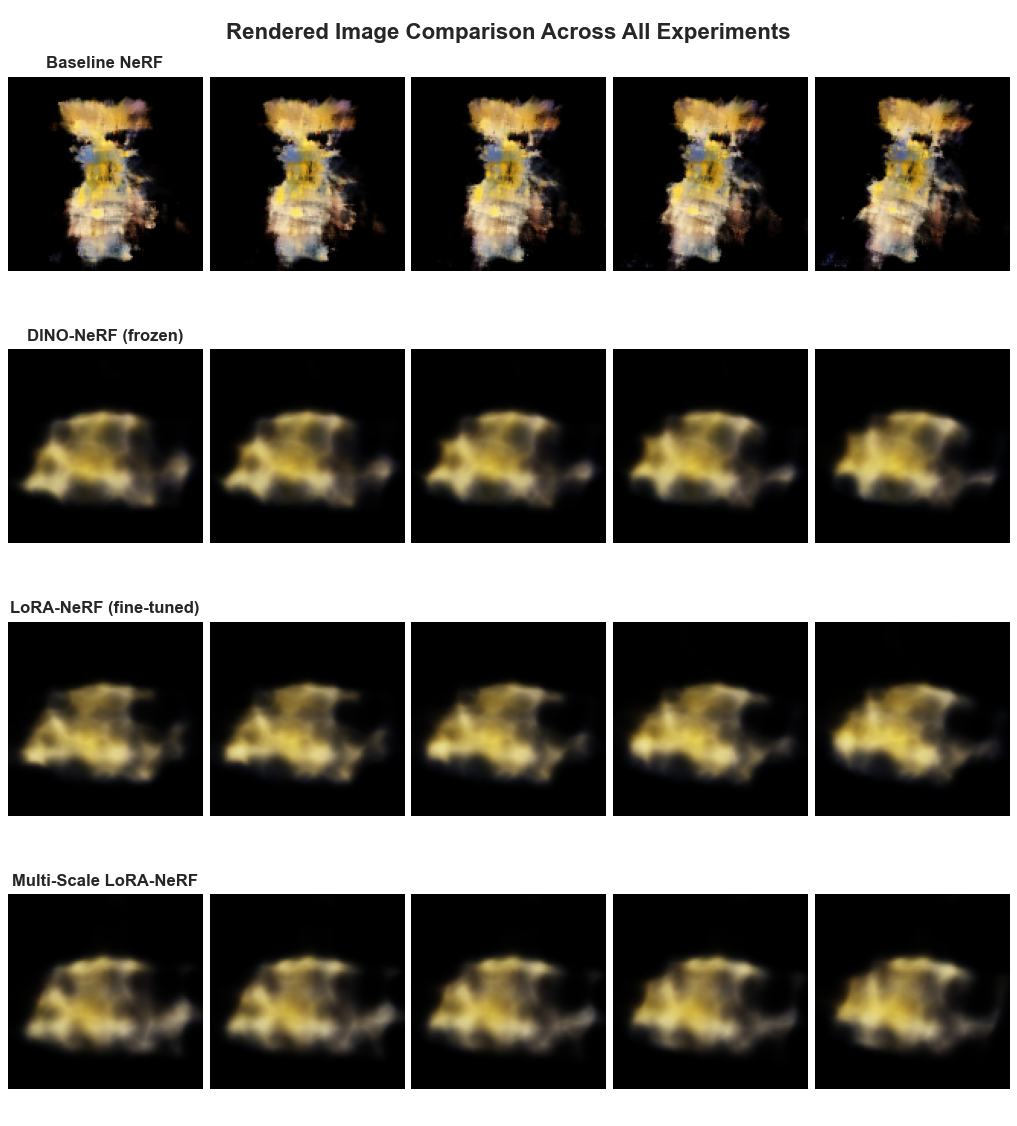
- Baseline NeRF: standard MLP + positional encoding + volume rendering, no external features
- DINO-NeRF (frozen): DINO patch features concatenated to NeRF input, weights frozen
- LoRA-NeRF: DINO features with Low-Rank Adaptation (LoRA) fine-tuning on few-shot views
- Multi-Scale LoRA-NeRF: multi-scale DINO feature pyramid fused with LoRA adaptation
Results
| Model | PSNR ↑ | SSIM ↑ | LPIPS ↓ |
|---|---|---|---|
| Baseline NeRF | 14.71 | 0.46 | 0.53 |
| DINO-NeRF (frozen) | 12.99 (−1.72) | 0.46 | 0.54 |
| LoRA-NeRF (fine-tuned) | 12.97 (−1.74) | 0.45 | 0.54 |
| Multi-Scale LoRA-NeRF | 12.94 (−1.77) | 0.44 | 0.54 |
Evaluated on the Blender Lego scene with extreme few-shot setup. Green = best. Red = worse than baseline.
Why Does DINO Hurt?
We hypothesize several causes for the degradation:
- Domain mismatch: DINO is trained on natural images; few-shot NeRF targets (e.g., Blender synthetic objects) have very different appearance statistics.
- Feature rigidity: Frozen DINO features encode ImageNet-level semantics, not the fine-grained 3D geometry NeRF needs to infer.
- Overfitting under LoRA: With only a handful of views, LoRA fine-tuning may overfit DINO features to specific view directions, harming generalization.
- Feature-geometry conflict: DINO features are 2D patch-level; conditioning a 3D volumetric MLP on them introduces an inductive bias mismatch.
Implications
Simpler, geometry-focused architectures may be more effective than feature-rich models for extreme few-shot 3D reconstruction. Future work should focus on geometric consistency losses, depth priors, and view-consistent regularization rather than semantic feature injection.
Why Publish a Negative Result?
Interpretability research, like all good empirical science, depends on people being honest about what doesn't work. A common failure mode in ML is to only publish positive results, leaving the community with a falsely optimistic picture of what techniques are reliable. This paper is a deliberate counterexample: DINO features are widely assumed to help few-shot NeRF, and this study shows systematically that they don't. Publishing it is a commitment to the same epistemic standard that AI safety research requires: report what you actually found, not what you hoped to find.
Citation
@article{sanjyal2024nerflimitations,
  title     = {Limitations of {NeRF} with Pre-trained Vision Features for Few-Shot 3D Reconstruction},
  author    = {Sanjyal, Ankit},
  journal   = {arXiv preprint arXiv:2506.18208},
  year      = {2025}
}