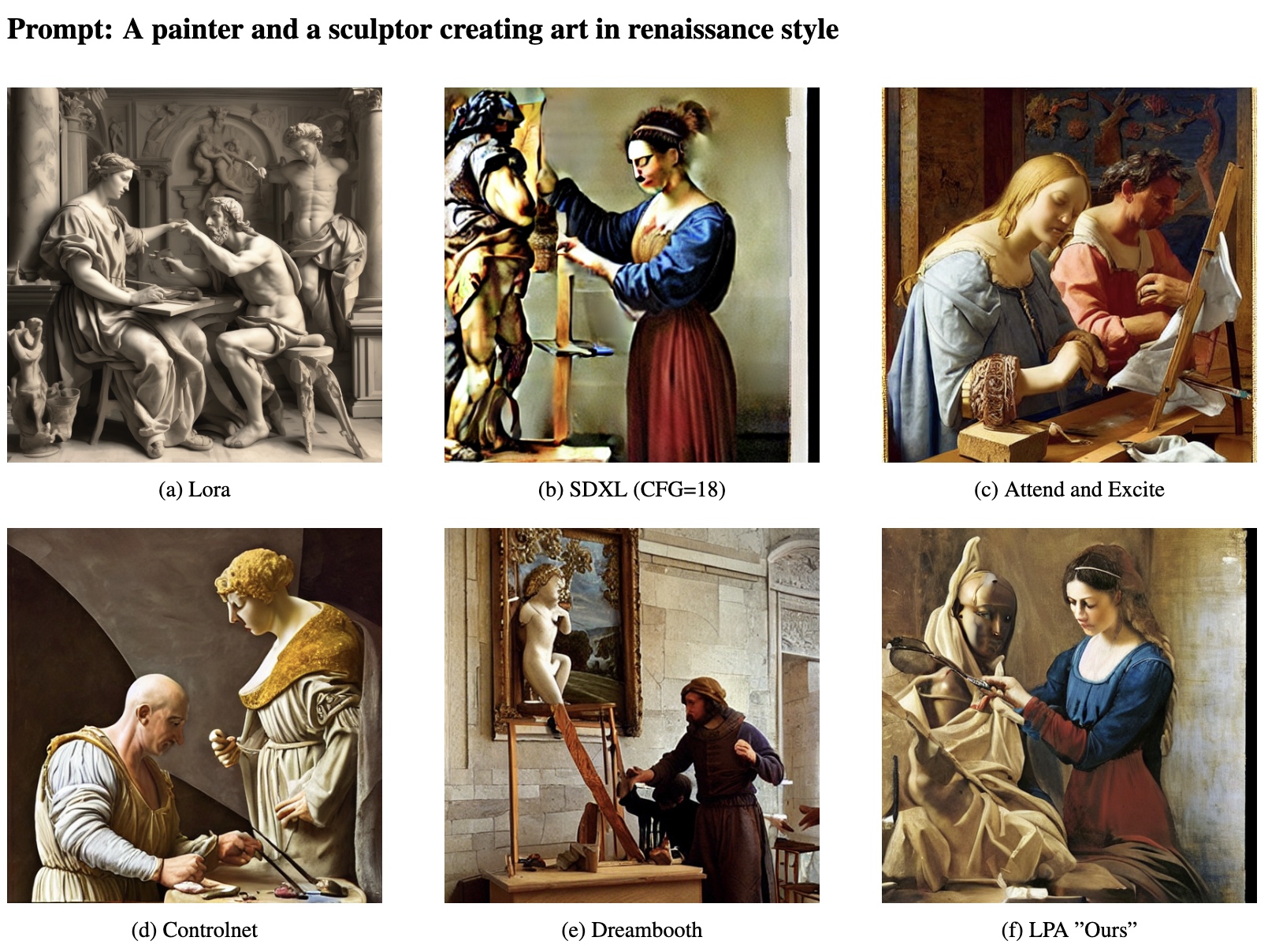
Problem
When a prompt like "A red car and a blue bicycle in watercolor style" is fed to SDXL or SD1.5, the model treats all tokens equally: the style bleeds unevenly across objects, and object boundaries tend to collapse. This is because standard cross-attention has no mechanism to scope style tokens to specific objects or to specific denoising stages.
Method: Local Prompt Adaptation (LPA)
Step 1: Parse
Split the prompt into content tokens (objects, layout) and style tokens (artistic style, texture) using a lightweight parser.
Step 2: Schedule
Define injection windows: content tokens are injected early (high-noise steps) to anchor layout; style tokens are injected later (low-noise steps) to apply texture.
Step 3: Inject
Selectively replace cross-attention keys/values in specified U-Net layers with the corresponding token subset at each timestep window.
Step 4: Generate
Standard DDIM/DPM++ sampling proceeds: no retraining, no fine-tuning, one config change.
The optimal configuration found through ablation is LPA Late Only with a 300–650 step injection window, which delivers the strongest balance of prompt alignment and style consistency.
Results
| Method | CLIP-Prompt ↑ | CLIP-Style ↑ | Training Required? |
|---|---|---|---|
| SDXL (vanilla) | 0.2841 | 0.2203 | – |
| SD1.5 (vanilla) | 0.2748 | 0.2184 | – |
| SDXL + CFG tuning | 0.2859 | 0.2218 | No |
| LPA Late Only (ours) | 0.2853 (+0.41%) | 0.2211 (+0.08%) | No |
Results on T2I benchmark (SDXL comparison) and custom 50-prompt style-rich benchmark. All improvements with zero diversity loss.
Key Contributions
- Training-free: No fine-tuning or additional parameters needed.
- Model-agnostic: Works with SDXL, SD 1.5, and any U-Net-based diffusion model.
- Injection window ablation: Systematic study of 6 parser × 4 window configurations.
- Practical: Single config change: drop-in improvement for any generation pipeline.
Transferable Skills
LPA works by analyzing and surgically modifying cross-attention patterns, deciding which tokens attend to which layers at which timesteps. This is precisely the skill that interpretability research applies to language models: reading cross-attention to understand what the model is doing, then intervening on specific attention edges to test causal hypotheses. The injection-window ablation here (6 parsers × 4 windows, systematically evaluated) is also a model for the kind of controlled ablation study that mechanistic interpretability depends on.
Citation
@article{sanjyal2025lpa,
  title     = {Local Prompt Adaptation for Style-Consistent Multi-Object Generation in Diffusion Models},
  author    = {Sanjyal, Ankit},
  journal   = {arXiv preprint arXiv:2507.20094},
  year      = {2025}
}